
Probe follows the corridor.
Sees through the surface.
Larger survey airframe carrying multi-frequency, multi-power ground-penetrating radar plus frequency-domain EM, magnetometer, hyperspectral and radiometric payload. Frequency picks the resolution, power picks how deep the signal still returns useful contrast — so one pass sees shallow, mid, and deep at once. Flies the corridors Scouts have already cleared.
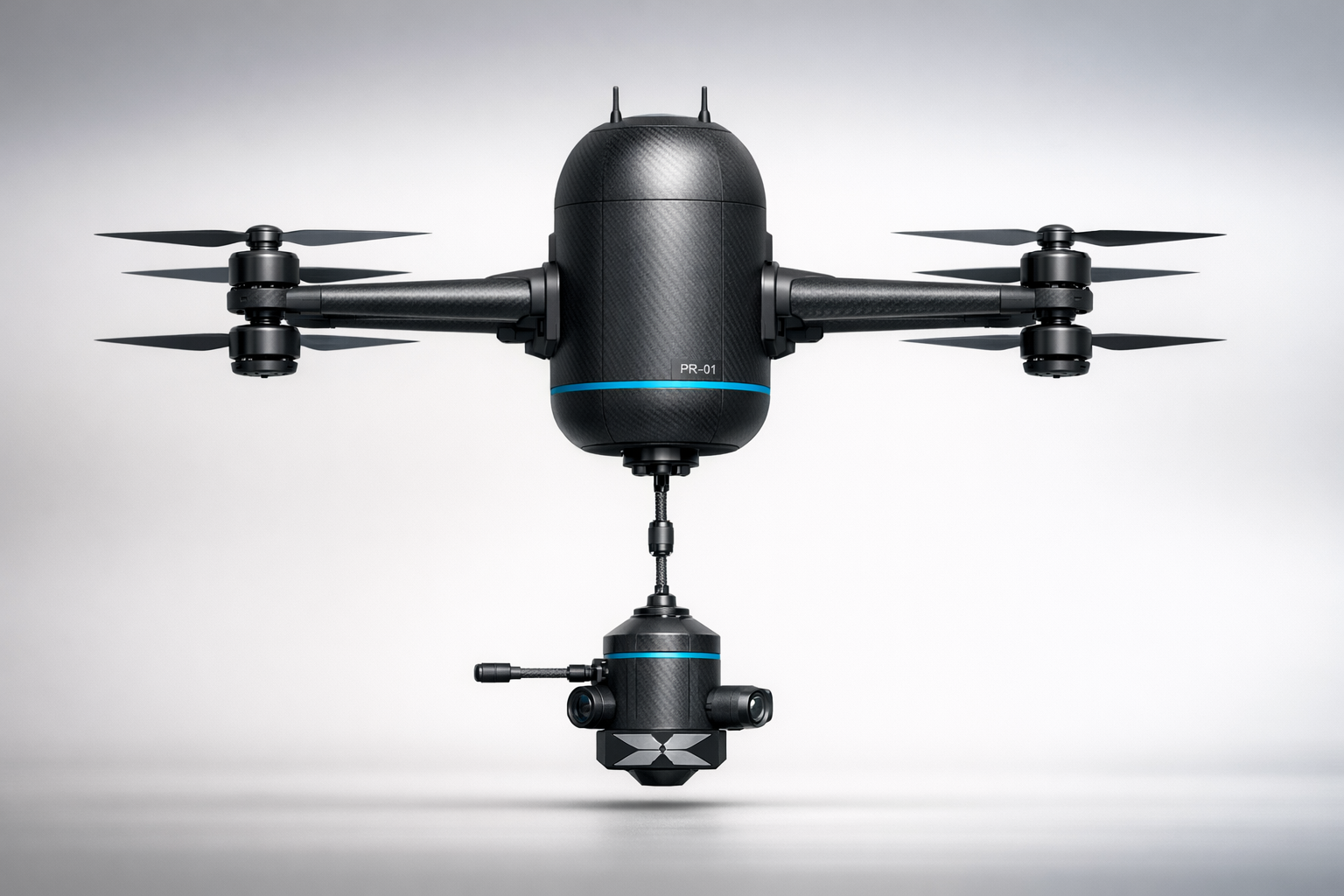
Endur Probe
The geophysics sibling of the Scout.
Carbon-fiber capsule body, twin coaxial-rotor arms with four blades per side, and a gimbaled multi-sensor pod suspended on a vibration-isolated boom beneath the airframe. Roughly 30% larger envelope than the Scout to carry the heavier sensor stack — extra mass goes to bigger transmit amplifiers and larger antennas so the same sensor can push into deeper bands without a longer flight.
- Payload
- GPR · FDEM · Mag · Hyper · Radio
- Frame
- Carbon-fiber capsule + tube arms
- Rotors
- 4 (2× coaxial pair)
- Battery
- Same 6-pack LiPo stack as Scout
- AUW · est.
- ≈ 3.5–4.0 kg, payload-dependent
- Endurance · est.
- ≈ 10–15 min, full payload
- Subsurface depth
- 0–30 m · multi-freq + multi-power
- Depth bands
- Shallow · mid · deep · power swept per pass
- Autonomy
- Corridor-following, on-device
- 30 m
- Subsurface depth
- Multi-frequency · multi-power
- 5
- Sensor types
- GPR · FDEM · Mag · Hyper · Radio
- ≈ 4 kg
- All-up weight
- Payload-dependent, est.
- 10–15 min
- Endurance
- Per LiPo pack, est.
Let us scan your land.
A small number of free reference surveys in 2026 — landowners, ranchers, exploration juniors. You give us permission and ground truth; we tow the trailer out, fly the survey, and hand you the heatmaps.